 This is where I found the bottle.
 Here's the soggy note. I'll let you know if I find anything out.
This is where I found the bottle. Here's the soggy note. I'll let you know if I find anything out.
Here's the soggy note. I'll let you know if I find anything out.
This is where I found the bottle. Here's the soggy note. I'll let you know if I find anything out.

 Here's Aaron checking out the ship.


 Here are the visitors and volunteers pulling the verbesina.
 Here's a red-tailed tropic bird chick that was under one of the trees. It looks like it hatched yesterday or the day before.
Here is an old barracks building that isn't used anymore.
The ceiling is falling in on the pool table.
Here's a bird picture for the day. This is near the old fuel farm.
 Here are pictures of the harbor buildings near the finger piers. This is the old harbor office.
 This is a view of some of the junk that's left in this building. Most of the buildings have at least some junk, and some have a lot. Some of it is useful, but most isn't.
 This building was where the old contractor had their scuba office. We just use it to store life jackets for the boats.
 There still is a hyberbaric chamber in the back of that building. It needs some work but is probably fixable.
 While I was taking the building pictures, I saw this frigate bird sunning itself on a branch.

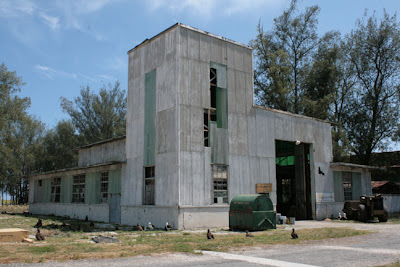 Here's the "Parachute Building". I guess this is where they used to hang parachutes to prepare them. Now we use it for the recycling center.
 This is the old machine shop. This building has a serious lead paint problem. A few people came out a couple of months ago to see what it would take to clean it up. That's why there's one little painted section. Someone came out last week to train the Chugach guys on lead paint removal, so sooner or later we'll get it cleaned up I hope. The albatross chicks around the buildings with lead paint die frequently from developmental problems.

Inside the machine shop there are the usual tools such as drill presses, saws, etc. I doubt if any of them are functional because they are very rusty. This picture shows a big lathe and a shark cage. I assume that's here from the days when people were allowed to scuba dive here. It's really interesting to check these places out.

 This white tern found a decent spot to lay an egg on Eastern Island.
 The red-footed booby chicks are hatching now. It will take a while to get the red feet.
 The mullets swim around the piers on the surface looking for food. This fish looks like it's about 3 pounds or so.


 Here's another shot from Saturday. Ben, Kristin, and Brandon are coming back to the beach after some kayaking.
 I was over at the cliffs on the north beach taking pictures. The cliffs are only 2 feet tall, but it's still interesting to see the same erosion patterns as real rock cliffs.
 I love the colors of the water.


 Here is the "before" picture of Radar Hill with the haole koa and castor beans.
 The "after" picture, where you can see the old radar installation.
 An albatross chick has a good view now that the trees are gone. It can also climb pretty well apparently.

 This is an almost albino Laysan albatross out near bulky dump. It has a little bit of pigment, but nowhere near as much as it's neighbor.
 The albatross like to skim along the waves as they are breaking.
 Here are the ducklings at brackish pond.
 Here is a white tern family. This is the chick I showed you a few days ago with the good parent. There are a lot of chicks around right now. There are white terns, Laysan albatrosses, Black-footed albatrosses, red-tailed tropic birds, and Bonin petrels. Soon there will be wedge-tailed shearwaters, brown noddies, frigate birds, and red-footed boobies also.
There are a few wedge-tailed shearwaters around now. These two (there's one in the shadow behind the obvious one) found a decent nesting spot under a log surrounded by verbesina.


 As you can see, this building needs some serious renovation. This is the 2nd floor, which you can see in the top picture. There are holes in the floor and concrete is falling from the ceiling. I wouldn't walk on the floor in this picture at all since the only thing keeping someone from falling through are the tiles. There is money for the restoration of this building since it is a historic structure, so in about 4 years it should be fixed up.
 Kristin and Dana are planting some bunch grass on one of the revetments that used to protect aircraft, fuel, or other important things on Eastern Island. Now, the ducks like to nest on high ground, so in another year or so it may be thick enough for them.
 John is digging out a clump of cyperus from the sunset seep.
 A sooty tern is taking a drink.


